106715 Belle Dr, Checotah, OK 74426, United States
Open 24/7
106715 Belle Dr, Checotah, OK 74426, United States

- Services
- About Us
- Service Area
- Gallery
- Testimonials
- Blog
- Contact Us
CLICK TO CALL US NOW (918) 358-0020
August 5, 2026
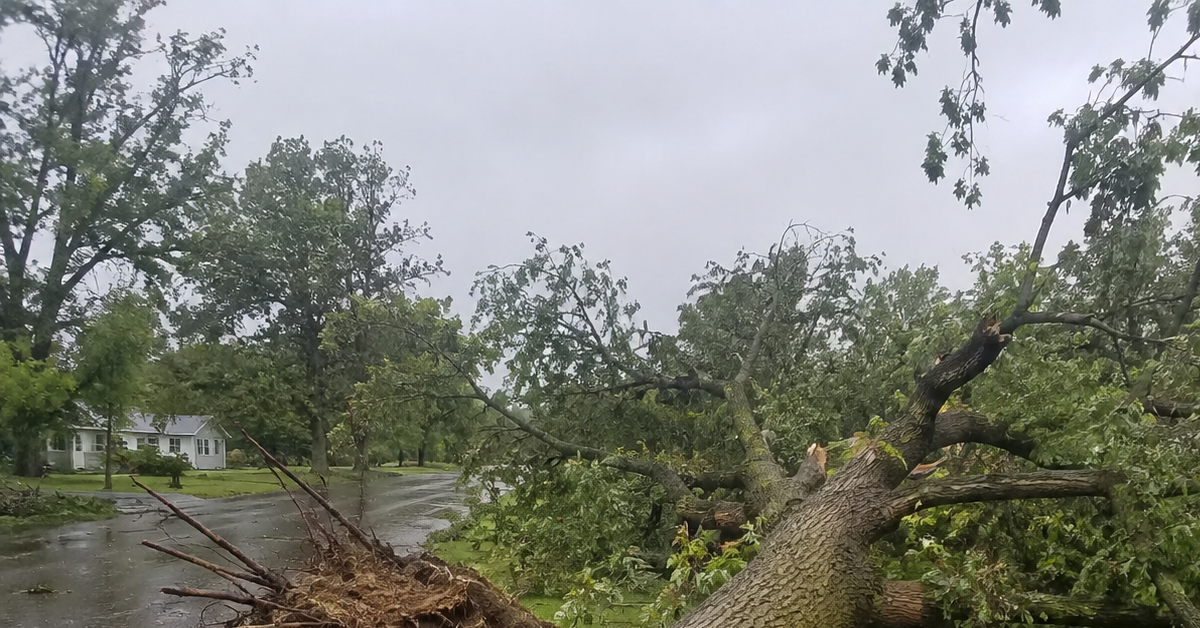
Eastern Oklahoma’s weather combines heavy rain, straight-line winds, hail, and occasional tornadic activity. Some trees tolerate that abuse; others become liabilities as soon as the soil saturates and wind loads the canopy.
The trees that fail first typically share a few traits: shallow root systems in clay, weak branch unions, hidden disease or decay, and unmanaged deadwood over structures. Knowing which trees are most vulnerable and why helps property owners act before the next front turns a manageable issue into an emergency.
Much of Eastern Oklahoma sits on clay soils. Instead of deep taproots, many mature trees develop wide, shallow root systems. In dry weather, that can work. Once clay is saturated, though, the soil loses shear strength and roots lose their grip.
At the same time, a rain-soaked canopy weighs far more than a dry one. Every gust transfers more load through the trunk into a root system sitting in weakened soil. That’s when entire trees uproot, often pulling a disk of turf and soil up with them.
Warning signs:
Any large tree with those symptoms in clay, especially near a structure or driveway, should be treated as a critical pre-storm priority.
Bradford pear is one of the most storm-prone ornamentals in the region. It forms tight, upright branch angles with included bark- classic weak unions. As the tree matures and fills out, those unions carry more weight and leverage but never really strengthen.
Under high wind or ice load, mature Bradford pears frequently:
Because these trees were often planted near homes, driveways, and sidewalks, failures can easily land on roofs, vehicles, and access routes.
Homeowners usually have three realistic options:
Leaving a mature Bradford pear untouched in a high-storm area is a calculated risk that many owners eventually decide isn’t worth it.
Some of the most dangerous storm-prone trees don’t look dramatic yet they’re already weakened internally by disease or decay. Oaks affected by oak wilt or root-rot fungi are a common example.
Before symptoms become obvious, these trees often have:
Eventually you may see fungal conks, thinning canopy, scattered dead limbs, or odd growth patterns where lower shoots appear vigorous while upper branches decline. By that point, structural integrity is often already reduced.
When heavy rain and wind move in, those weakened trees tend to fail faster and harder than healthy neighbors, snapping at decay pockets or uprooting where rot has undermined anchorage.
Any tree showing fungal growth at the base, unexplained canopy thinning, or increasing deadwood deserves a professional evaluation to decide if treatment, reduction, or removal is the safest option before storm season.
Fast-growing species like sweetgum are common across Eastern Oklahoma because they establish quickly and provide fast shade. The tradeoff is structural.
Rapid growth often produces:
Overmature or previously storm-damaged sweetgums frequently carry hidden cracks or stressed unions that only fail when the next strong system arrives. Similar issues show up in other fast-growing softwoods that were never structurally pruned while young.
Key red flags:
Corrective pruning, cabling, or, in some cases, removal can dramatically reduce the odds of major breakage under wind or ice.\
Species matters, but location plus condition is ultimately what damages property. Deadwood will fail, it’s just a question of timing and trigger. When dead limbs hang over roofs, parking areas, decks, or utility lines, any storm can be the one that brings them down.
In Eastern Oklahoma’s climate, deadwood over structures is one of the most direct causes of storm-related property damage. Larger dead limbs don’t flex like live wood; they simply snap when wind, ice, or weight push them beyond their limit.
Look for:
Proactive deadwood removal is straightforward, relatively inexpensive, and often prevents the most common “tree through roof” scenarios.
Heavy rain and high wind are each stressful on trees, but the worst failures happen when they arrive at the same time, which Eastern Oklahoma sees often. A rain-loaded canopy weighs more, increasing the force on branches, trunk, and root system with every gust. Meanwhile, saturated clay soil has already lost much of its ability to hold roots in place. Extra weight above plus less resistance below is a recipe for uprooting and trunk failure.
It’s also why failures continue after the main line of storms has moved on. Soil stays saturated for days, especially in low-lying or poorly drained areas. Even moderate winds during that window can bring down marginal trees that would normally survive.
Eastern Oklahoma rarely sees just one major storm during peak season. Systems can track through in clusters. A tree that barely holds through the first event may be significantly weakened by the time the second arrives.
Hidden root damage, minor trunk cracks, and stressed unions can accumulate. The next round of wind or ice is often what finally pushes the tree past its limit. That’s why post-storm checks matter. Catching new lean, soil cracking, or fresh deadwood early gives time to act before the next event.
Waiting for visible failure is the most expensive way to manage trees in this climate. Targeted maintenance before storm season dramatically lowers risk:
These steps cost far less than emergency removal, structural repairs, and cleanup after a major failure.
Checotah Tree Service helps Eastern Oklahoma property owners identify and address storm-related tree risks before they become emergencies. Our team provides professional pre-storm inspections to evaluate tree health, root stability, weak branch unions, deadwood, and structural concerns.
We assess trees affected by heavy rain, saturated clay soil, high winds, and storm damage to determine the safest solution, whether that involves pruning, monitoring, removal, or emergency response. Our experienced crew uses specialized equipment to safely handle hazardous trees near homes, driveways, and other structures.
With 24/7 emergency tree service and storm cleanup throughout Checotah, Eufaula, Muskogee, Tahlequah, McAlester, and surrounding areas, Checotah Tree Service helps protect properties before and after severe weather events.
In saturated clay, root anchorage weakens. Trees with shallow root plates are more likely to lift and topple as a unit than just shed limbs.
Mature Bradford pears carry real storm risk due to weak branch unions. Some owners manage them with structural pruning; others plan for removal and replacement.
Fungal conks at the base, canopy thinning, scattered dead limbs, and unusual growth patterns are all signs that should trigger a professional inspection.
April through June for severe wind and tornadic activity, and winter for ice loading on branches.
Pre-storm inspections that identify deadwood, weak unions, root instability, and disease before the season hits are the most cost-effective protection.
Summary Checklist: Storm-Prone Tree Risk Factors
| Risk Factor | Priority | Recommended Action |
| Shallow Root Plate in Clay Soil | Critical | Inspect root stability and anchorage before storm season begins. |
| Bradford Pear or Weak Branch Unions | High | Perform structural pruning or consider replacing high-risk trees. |
| Oak Wilt or Root Rot | High | Schedule a professional arborist evaluation and appropriate treatment. |
| Deadwood Over Structures | Critical | Remove hazardous dead branches before severe weather arrives. |
| Co-Dominant Trunks or Weak Branch Unions | Medium | Assess the tree for cabling, bracing, or corrective structural pruning. |
Most catastrophic tree failures in Eastern Oklahoma could have been avoided with work done before the storm hit.
Identifying high-risk trees, especially those with shallow roots in clay, weak unions, disease, or deadwood over structures, gives you the chance to fix problems while they’re still manageable.
If this sounds like your property, or you’d rather know than guess, a pre-storm inspection is the simplest way to get clear answers.
Checotah Tree Service provides pre-storm assessments and 24/7 emergency response across Checotah, Eufaula, Muskogee, Tahlequah, McAlester, and nearby communities.
What Our Clients Say

Highly recommend Checotah Tree Service! They were professional, efficient, and did an amazing job from start to finish. It's hard to find a company that takes this much pride in their work, but they definitely delivered. If you're needing tree work done, Jeff is the guy to call.
Excellent work and will be using again! They removed a large tree close to my house, ground two stumps, and cleaned everything up beautifully including blowing sawdust off my porch. They even placed the wood in the perfect spot for burning. I will definitely recommend them!
These guys were absolutely amazing. They cut down two trees that were between power lines and next to the house. They cleaned up the area and left it in better shape than when they arrived. I will recommend them to anybody who is looking for tree removal and I will definitely use them again.
Fantastic job! The crew took out a large tree located in my front yard with careful precision and did an amazing job of cleaning up. Regular updates of pics and videos throughout the process and very reasonable price.
Excellent, professional service! They did the work they quoted in a timely manner, and even cleaned up a few extra problem roots. These are my go-to guys for tree work from now on!
Jeff & his crew did an outstanding job. I had quite a challenging job & they absolutely nailed it. I have more trees to remove this fall & I can tell you they are the only company to call.
If you've got a tree concern anywhere across Eastern Oklahoma, the next step is straightforward.
Call Checotah Tree Service today at
(918) 358-0020
for your free consultation.
Checotah Tree Service • Checotah, OK • (918) 358-0020 • 24/7 Emergency Service

From the first phone call to the final cleanup, here's how a Checotah Tree Service project actually runs.
Call (918) 358-0020 or contact us online. For emergencies, we dispatch a crew immediately. For routine work, we schedule a free on-site consultation at a time that works for you. Phone and virtual consultations are also available at no charge.
We come out to the property, walk it with you, evaluate the trees and the access, identify any safety concerns, and ask about anything we need to know before quoting. This is the conversation where you tell us what you've noticed, and we tell you what we see - including honest recommendations on what work is needed and what isn't.
Detailed written estimate covering scope, timeline, and total price, locked in by our No-Surprise Guarantee. Take your time deciding - there's no pressure to sign on the spot, and the quote is good whether you book now or in a couple of weeks.
Crew arrives on time, walks the plan with you, executes the work safely and efficiently, and completes a full cleanup before leaving. A final walkthrough confirms you're satisfied with the result.
Fill out the form below, and we'll get back to you.