106715 Belle Dr, Checotah, OK 74426, United States
Open 24/7
106715 Belle Dr, Checotah, OK 74426, United States

- Services
- About Us
- Service Area
- Gallery
- Testimonials
- Blog
- Contact Us
CLICK TO CALL US NOW (918) 358-0020
September 2, 2026
Every storm-damage call starts with a different set of conditions. One tree may be lying across a driveway. Another may still be standing with a split trunk, lifted roots, or a large limb caught above a roof. Our job is to understand what moved, what remains unstable, and what must be protected before any cutting begins.
When we respond to storm-damaged trees in Muskogee, we follow a careful process from the initial call through the final property walkthrough. That process helps us decide which hazards need the fastest attention, which trees may be saved, and which removal method fits the property.
If a tree is on a structure, blocking essential access, or threatening people, call Checotah Tree Service at (918) 358-0020. Our Checotah-based team provides 24/7 emergency assistance in Muskogee and other Eastern Oklahoma communities.
Storm damage changes how a tree carries its weight. A limb that once transferred force through a sound branch union may be hanging by torn fibers. A trunk may be supported by a roof, another tree, or a partially attached root plate. Cutting one section can shift pressure into another part of the tree.
Bent branches and trunks can also hold trapped tension. Wood under tension may split, roll, drop, or spring toward the person making the cut. That is why property owners should not operate a chainsaw on storm-damaged wood or try to pull a fallen tree with a personal vehicle.
Our safety assessment comes before the saws. We need a clear picture of the tree, the surrounding property, utilities, access, and potential movement before we choose how to proceed.
The first call helps us understand the urgency and prepare for the conditions at the property. We ask focused questions rather than expecting you to diagnose the tree.
Useful details may include:
Do not approach an unstable tree to answer a question or get a closer picture. We would rather work with limited information than have you stand beneath a hanging limb or inside a possible fall zone.
If the tree has damaged an occupied room, keep everyone out of that part of the building. Move people and pets away from the yard, driveway, or parking area affected by the tree. Treat all downed utility lines as active and contact the utility provider before approaching any tree involving electrical service.
Once we arrive, we look at the entire scene before focusing on the visible break. A storm-damaged tree interacts with the ground, nearby structures, other trees, and any object supporting its weight. A branch on a roof may be connected to a split trunk, while a leaning trunk may be held temporarily by roots that are already pulling out of saturated soil.
Our team evaluates conditions such as:
We also look beyond the most obvious damage. A large broken limb may draw attention away from a crack lower on the trunk. Soil movement on the opposite side of a lean may show that the root plate has started to rotate. Damage in the upper canopy may remain hidden from the angle visible at ground level.
No cutting begins until we understand how the tree is likely to behave. If electrical lines are involved, the utility provider must address the electrical hazard before tree work can proceed safely.
Storm damage does not automatically mean removal. Some trees remain structurally stable after losing one or more limbs and may recover with appropriate pruning. Others have damage to the trunk or roots that makes continued retention unsafe.
We consider the tree as a whole, including:
The same physical damage can lead to different recommendations depending on location. A tree with a damaged limb in an open area presents a different exposure than a tree with the same defect above a bedroom, business entrance, or busy driveway.
Possible outcomes include repair pruning, removal of individual damaged branches, monitoring, additional professional evaluation, or complete removal when the tree cannot be made reasonably safe. Our approach is straightforward. If the tree can be retained safely, we say so. If the trunk, roots, or major structure has failed, we explain why removal is the responsible choice.
Readers who want more information about corrective branch work can visit our tree trimming and pruning page. Planned and hazardous removals are covered in more detail on our tree removal service page.
The work plan depends on the condition of the tree, the available space, nearby structures, utility hazards, and equipment access. There is no single removal method that fits every storm-damage call.
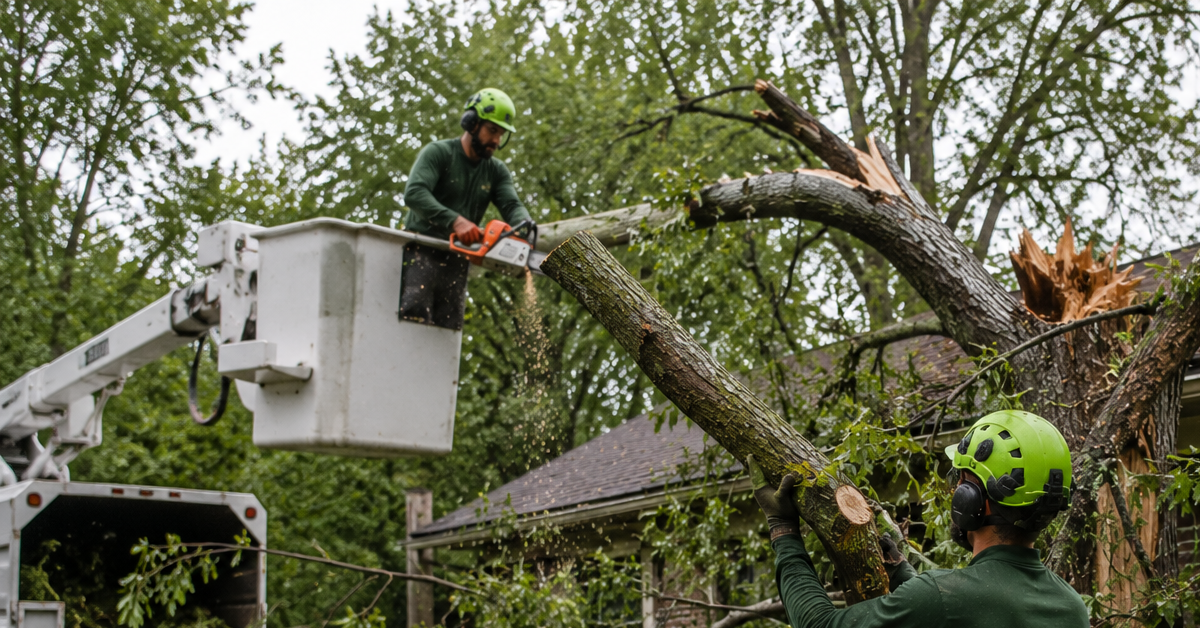
Controlled rigging may allow us to lower branches or trunk sections into a designated area. Sectional dismantling can be used when the tree must be taken apart in smaller pieces because a full drop is not safe. Crane-assisted removal may be appropriate for compromised trees over structures or sites without a usable drop zone.
On a tree that can be saved, the plan may center on removing broken wood while preserving sound branches and the tree’s remaining structure. We avoid turning repair pruning into unnecessary removal.
Restricted access also changes the plan. We consider how workers and equipment can enter and leave the property, where material can be lowered, and how debris can be moved without creating another hazard. If utility lines are involved, our work must be coordinated with the utility provider’s safety requirements.
This is professional decision-making, not a cutting sequence that property owners should try to copy. Climbing a damaged tree, rigging a suspended limb, or cutting tension-loaded wood without the proper training and equipment can cause sudden, uncontrolled movement.
Before work starts, we identify what the tree could strike and what our equipment must pass near. That includes roofs, siding, garages, outbuildings, vehicles, fences, gates, driveways, walkways, landscaping, garden beds, and nearby utility infrastructure.
Our plan may include controlled lowering so branches do not fall freely into a restricted area. Plywood, tarps, roof protection, ground mats, fence boards, or traffic control may be used where conditions call for them. Equipment routes are planned around vulnerable areas of the property.
Ground conditions matter after heavy rain. Saturated soil can be vulnerable to rutting and may also signal reduced root stability around other trees. We account for both the damaged tree and the route needed to complete the work.
If a tree is resting on a building, we remove sections deliberately to avoid shifting more weight onto the damaged structure. Tree work addresses the tree hazard, but it does not replace an evaluation of roof, structural, electrical, or utility damage by the appropriate professional.
Storm-related property damage may involve an insurance claim, especially when a tree has struck a covered structure. Coverage is not automatic. It depends on the policy, the cause of the loss, the damaged property, and the carrier’s decision.
We can provide photographs, written assessments, and itemized estimates that an adjuster can review. Direct coordination or billing may be available when the carrier supports it. You should contact your insurer directly to report the loss, confirm coverage, and ask what documentation is required.
If you take your own photos, do so only from a safe location. Do not enter a damaged room, walk beneath hanging limbs, or move closer to a downed line for a better angle. Wide images showing the tree, affected property, and surrounding area can be more useful than a close-up taken from an unsafe position.
Our role is to document the tree conditions and the scope of our work accurately. We do not promise that an insurance carrier will approve a claim or reimburse a particular expense.
Removing the immediate hazard is only part of the job. Broken limbs, brush, logs, chips, and smaller storm debris must be handled according to the agreed scope so the work area can be used safely again.
Brush may be chipped, and larger wood may be hauled away or stacked for firewood if requested. Our cleanup includes raking the work area and clearing debris from driveways and walkways. For properties with widespread damage beyond one tree, our storm damage cleanup service provides more information about debris removal and site cleanup.
Before leaving, we complete a final walkthrough with you. This gives you a chance to see the finished work, ask questions, and point out anything that needs additional attention. We also check the immediate work area for remaining hazards connected to the completed scope.
The final walkthrough matters because storm response can involve several moving parts. A clear review confirms what was removed, what was retained, how debris was handled, and whether any tree should be monitored after the work.
Muskogee and Muskogee County experience weather that can damage trees in different ways. Severe thunderstorms and straight-line winds can shear off limbs or push an entire canopy in one direction. Tornado activity can produce intense, uneven loading, while lightning may damage bark and internal wood.
Heavy rainfall can saturate the soil and reduce the support around roots. A tree may begin leaning during the storm or continue moving as the ground remains wet. Hail can strip foliage and injure bark and smaller branches. Winter ice adds substantial weight to the canopy and can split branch unions or break tops.
Mature trees near homes, driveways, roads, commercial buildings, and utility lines make storm response more complex. Our process accounts for both the tree’s condition and the property around it. General information about our local services is available on our Muskogee tree service page.
Call promptly if a tree is on an occupied structure, blocking the only access route, touching utility lines, or actively shifting. A split trunk, lifted root plate, fresh soil cracks, increasing lean, or large hanging limb can also signal an urgent hazard.
While waiting for professional help:
Our emergency tree service is available 24/7. Response order and timing can depend on active hazards, weather, access, road conditions, and the number of calls after a widespread storm.
If you are dealing with a fallen, split, leaning, or otherwise unstable tree, call (918) 358-0020 and tell us what happened. Let us know what the tree is touching or threatening, whether access is blocked, and whether utility lines are involved. Do not approach the tree to gather details you cannot see safely.
We will assess the conditions, explain the available options, and build the work plan around the tree and your property. Checotah Tree Service serves Muskogee, Oklahoma, and surrounding areas from our home base in Checotah.
What Our Clients Say

Highly recommend Checotah Tree Service! They were professional, efficient, and did an amazing job from start to finish. It's hard to find a company that takes this much pride in their work, but they definitely delivered. If you're needing tree work done, Jeff is the guy to call.
Excellent work and will be using again! They removed a large tree close to my house, ground two stumps, and cleaned everything up beautifully including blowing sawdust off my porch. They even placed the wood in the perfect spot for burning. I will definitely recommend them!
These guys were absolutely amazing. They cut down two trees that were between power lines and next to the house. They cleaned up the area and left it in better shape than when they arrived. I will recommend them to anybody who is looking for tree removal and I will definitely use them again.
Fantastic job! The crew took out a large tree located in my front yard with careful precision and did an amazing job of cleaning up. Regular updates of pics and videos throughout the process and very reasonable price.
Excellent, professional service! They did the work they quoted in a timely manner, and even cleaned up a few extra problem roots. These are my go-to guys for tree work from now on!
Jeff & his crew did an outstanding job. I had quite a challenging job & they absolutely nailed it. I have more trees to remove this fall & I can tell you they are the only company to call.
If you've got a tree concern anywhere across Eastern Oklahoma, the next step is straightforward.
Call Checotah Tree Service today at
(918) 358-0020
for your free consultation.
Checotah Tree Service • Checotah, OK • (918) 358-0020 • 24/7 Emergency Service

From the first phone call to the final cleanup, here's how a Checotah Tree Service project actually runs.
Call (918) 358-0020 or contact us online. For emergencies, we dispatch a crew immediately. For routine work, we schedule a free on-site consultation at a time that works for you. Phone and virtual consultations are also available at no charge.
We come out to the property, walk it with you, evaluate the trees and the access, identify any safety concerns, and ask about anything we need to know before quoting. This is the conversation where you tell us what you've noticed, and we tell you what we see - including honest recommendations on what work is needed and what isn't.
Detailed written estimate covering scope, timeline, and total price, locked in by our No-Surprise Guarantee. Take your time deciding - there's no pressure to sign on the spot, and the quote is good whether you book now or in a couple of weeks.
Crew arrives on time, walks the plan with you, executes the work safely and efficiently, and completes a full cleanup before leaving. A final walkthrough confirms you're satisfied with the result.
Fill out the form below, and we'll get back to you.