106715 Belle Dr, Checotah, OK 74426, United States
Open 24/7
106715 Belle Dr, Checotah, OK 74426, United States

- Services
- About Us
- Service Area
- Gallery
- Testimonials
- Blog
- Contact Us
CLICK TO CALL US NOW (918) 358-0020
September 16, 2026
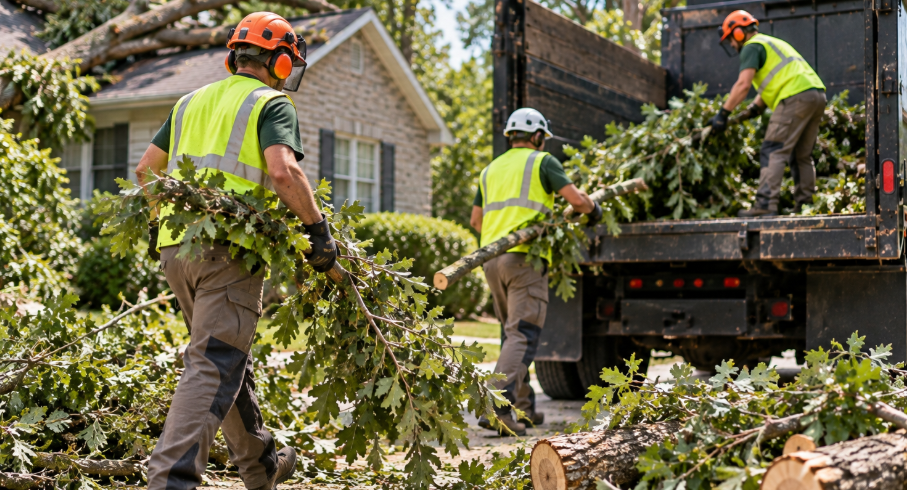
When you call a tree service for an emergency, the response typically follows four key stages, often within hours rather than days. The process usually begins with a live phone assessment, followed by crew dispatch with equipment suited to the specific hazard. Next, the crew conducts an on-site safety evaluation before carrying out controlled tree removal and cleanup.
For property owners in Eastern Oklahoma, understanding these steps can make a stressful situation more manageable, especially when a storm leaves a tree on a roof, blocks access, or creates a dangerous lean. Knowing what to expect can also provide clearer expectations about response times and potential costs. Let’s explore each step in detail.
A genuine emergency tree call should be answered by a live person, not a voicemail box, especially outside normal business hours. During this call, the dispatcher gathers key details that shape everything that follows, i.e. –
Property owners are typically asked to describe the situation in plain terms rather than technical language, since the crew will confirm specifics on arrival.
This phone assessment also determines urgency triage. A tree resting on a roof or tangled in power lines gets higher priority because it poses an ongoing risk of further collapse or electrocution. A tree that has already fallen completely in an open yard is comparatively stable, but both situations still require a timely emergency response.
Once the situation is understood, the tree service firm dispatches a crew with equipment matched to the specific hazard.
During active storm events, multiple emergency calls often come in simultaneously across a service area, so dispatch also involves real-time prioritization. Crews are typically routed to life-safety hazards first, meaning trees on homes, trees blocking the only access route to a property, or trees threatening power lines, before addressing situations that are serious but more stable, such as a tree down in a side yard away from structures.
When the crew arrives, the first thing that happens is not cutting, it’s assessment. The crew walks the site to confirm what the tree is doing structurally: whether it’s fully down, partially suspended, under tension, or still connected to a root system that could shift. This step matters enormously for what the industry sometimes calls “widowmakers.” These are partially failed trees that remain suspended in a neighboring tree’s branches. Such situations require a very different, more cautious removal approach than a tree that has already come completely to rest.
The crew also identifies hazards beyond the tree itself during this walk-through. This includes –
Homeowners are usually asked to keep a safe distance during this phase, and for good reason, since even a tree that looks stable can shift unexpectedly under its own weight or wind load.
Once the assessment is complete, the actual tree removal begins with a plan specific to the situation.
Throughout this stage, safety protocols govern pacing more than speed does. A complex removal over a home may take considerably longer than a similarly sized tree in an open yard, not because the crew is working less efficiently, but because the rigging and controlled lowering required to protect the structure simply takes more time to execute safely.
After the hazard itself is addressed, cleanup typically includes –
The U.S. Environmental Protection Agency recommends proper management of disaster debris, including vegetative debris such as tree branches, leaves, and logs, with local disposal and collection guidelines followed. U.S. EPA: Managing Debris After a Natural Disaster
Documentation for Insurance Claims
For storm-related emergencies, many tree services also provide documentation homeowners can use for insurance claims. This includes –
This step matters because insurance payouts for tree removal are often tied to whether the tree damaged a covered structure and whether it fell due to a covered peril such as wind or lightning, so clear documentation created at the time of service can make the claims process considerably smoother later.
Checotah Tree Service can help Eastern Oklahoma homeowners when a storm leaves a tree on a home, vehicle, driveway, or other structure. Our 24/7 emergency response starts with a phone assessment to understand the hazard and prioritize the situation. Once dispatched, our crew evaluates the tree, surrounding structures, utility lines, access points, and overall site conditions before cutting. We then choose the safest removal method, including sectional dismantling, controlled rigging, or crane-assisted removal when needed.
Checotah Tree Service’s team of licensed arborists works carefully to prevent additional property damage while removing unstable or fallen trees. After removal, we chip branches, haul away larger wood, and clear the affected area. We can also provide photos and written documentation to support storm-damage insurance claims.
Response time depends on the hazard level and how many calls are active in the area, but genuine life-safety emergencies, such as a tree on a home, are typically prioritized for the fastest possible response.
For true emergencies involving structures or blocked access, yes, crews often work overnight. Less urgent situations may be scheduled for the next available appointment instead.
It helps for someone to be available to point out access routes and any specific concerns, but the on-site assessment and safety protocols don’t require the homeowner to be present the entire time.
Crews will not work on a tree in contact with an energized line until the utility company has been contacted and the line addressed, since this is a life-safety issue outside a tree crew’s scope.
Usually not automatically. Stump grinding is typically a separate service that can be scheduled during or after the emergency visit, depending on the homeowner’s preference.
Pricing reflects after-hours labor, equipment needs, and complexity, such as whether rigging or a crane is required, rather than a flat rate that applies to every job equally.
Many companies provide photo documentation and written assessments suitable for adjusters, though direct claim filing is handled by the homeowner and their insurer.
Keep people and pets well away from the affected area, avoid attempting to move debris yourself, and photograph the damage if it’s safe to do so before the crew arrives.
| Stage | What Happens |
| Phone assessment | Dispatcher gathers hazard details and triages urgency |
| Dispatch | Crew and equipment matched to the specific situation |
| On-site assessment | Arborist evaluates structural risk before any cutting |
| Removal | Controlled cutting, rigging, or crane work as needed |
| Cleanup | Debris chipped, hauled, and site cleared |
| Documentation | Photos and written assessment for insurance if needed |
| Repairs | Handled by a separate contractor, not the tree service |
Knowing what to expect during an emergency tree call, from the first phone assessment through final cleanup, helps property owners stay calm and make better decisions in the moment. The most useful thing a homeowner can do while waiting for a crew is keep everyone clear of the hazard area and avoid the temptation to address a fallen or leaning tree without professional equipment. You can review safety guidelines on Ready.gov while waiting for assistance.
Contact Checotah Tree Service to reach a live person around the clock. We dispatch crews equipped for the specific hazard reported, ensuring Eastern Oklahoma property owners get an accurate assessment and a safe, efficient resolution from the very first call.
Reviewed by a Certified Arborist
This article has been reviewed by a certified arborist to ensure accuracy with emergency tree assessment protocols, rigging and removal practices, and safety procedures used across Eastern Oklahoma emergency response calls.
What Our Clients Say

Highly recommend Checotah Tree Service! They were professional, efficient, and did an amazing job from start to finish. It's hard to find a company that takes this much pride in their work, but they definitely delivered. If you're needing tree work done, Jeff is the guy to call.
Excellent work and will be using again! They removed a large tree close to my house, ground two stumps, and cleaned everything up beautifully including blowing sawdust off my porch. They even placed the wood in the perfect spot for burning. I will definitely recommend them!
These guys were absolutely amazing. They cut down two trees that were between power lines and next to the house. They cleaned up the area and left it in better shape than when they arrived. I will recommend them to anybody who is looking for tree removal and I will definitely use them again.
Fantastic job! The crew took out a large tree located in my front yard with careful precision and did an amazing job of cleaning up. Regular updates of pics and videos throughout the process and very reasonable price.
Excellent, professional service! They did the work they quoted in a timely manner, and even cleaned up a few extra problem roots. These are my go-to guys for tree work from now on!
Jeff & his crew did an outstanding job. I had quite a challenging job & they absolutely nailed it. I have more trees to remove this fall & I can tell you they are the only company to call.
If you've got a tree concern anywhere across Eastern Oklahoma, the next step is straightforward.
Call Checotah Tree Service today at
(918) 358-0020
for your free consultation.
Checotah Tree Service • Checotah, OK • (918) 358-0020 • 24/7 Emergency Service

From the first phone call to the final cleanup, here's how a Checotah Tree Service project actually runs.
Call (918) 358-0020 or contact us online. For emergencies, we dispatch a crew immediately. For routine work, we schedule a free on-site consultation at a time that works for you. Phone and virtual consultations are also available at no charge.
We come out to the property, walk it with you, evaluate the trees and the access, identify any safety concerns, and ask about anything we need to know before quoting. This is the conversation where you tell us what you've noticed, and we tell you what we see - including honest recommendations on what work is needed and what isn't.
Detailed written estimate covering scope, timeline, and total price, locked in by our No-Surprise Guarantee. Take your time deciding - there's no pressure to sign on the spot, and the quote is good whether you book now or in a couple of weeks.
Crew arrives on time, walks the plan with you, executes the work safely and efficiently, and completes a full cleanup before leaving. A final walkthrough confirms you're satisfied with the result.
Fill out the form below, and we'll get back to you.