106715 Belle Dr, Checotah, OK 74426, United States
Open 24/7
106715 Belle Dr, Checotah, OK 74426, United States

- Services
- About Us
- Service Area
- Gallery
- Testimonials
- Blog
- Contact Us
CLICK TO CALL US NOW (918) 358-0020
September 8, 2026
Once a severe storm moves through Eastern Oklahoma, it can be tempting to start picking up branches and clearing the driveway right away. Before you do, take a few minutes to look at the entire property from a safe location. A tree that is still standing may have a split trunk, a broken limb caught in the canopy, or roots that shifted in saturated soil.
Storm damage is not always obvious. Severe thunderstorms and straight-line winds can twist large limbs without bringing them down. Tornadic activity can place uneven pressure on a trunk and canopy. Heavy rain may weaken the soil around the roots, while hail and ice can damage bark, foliage, and branch unions. Some problems appear immediately. Others develop over the next several days or weeks.
The goal of your first inspection is not to decide how to cut or repair the tree yourself. It is to identify visible warning signs from the ground, keep people away from unsafe areas, and determine whether you need professional help. Do not climb a damaged tree, stand beneath hanging limbs, approach downed power lines, or use a chainsaw on storm-damaged wood under tension.
Here are the five areas we recommend checking after severe weather.
Start with the area around the tree before looking closely at the tree itself. Storm cleanup can wait until you know the yard is safe to enter.
Look from the house, street, or another protected location. Check whether a tree or large limb has fallen on a home, garage, vehicle, fence, driveway, or access road. Pay close attention to utility lines. A downed line may still be energized even if your power is out, and a branch touching a service drop can also carry electrical current.
Keep everyone away and contact the utility company if any tree, limb, or wire may be involved with electrical service. Call 911 if there is an immediate threat to life or a fire hazard. Do not move the branch, touch the fence beneath it, or walk close enough to take a better picture.
Other urgent warning signs include:
If it is safe to do so, take photos and short videos from a distance. Capture the whole tree, nearby structures, the ground around the trunk, and the direction of the damage. This can help document conditions for an insurance claim. Do not place yourself inside the tree’s potential fall zone just to get a closer image.
Call our team right away when a tree is on a structure, blocking essential access, tangled with utility lines, or actively shifting. We provide 24/7 emergency tree service throughout Eastern Oklahoma. For power-line involvement, the utility must first address the electrical hazard before tree work can proceed safely.
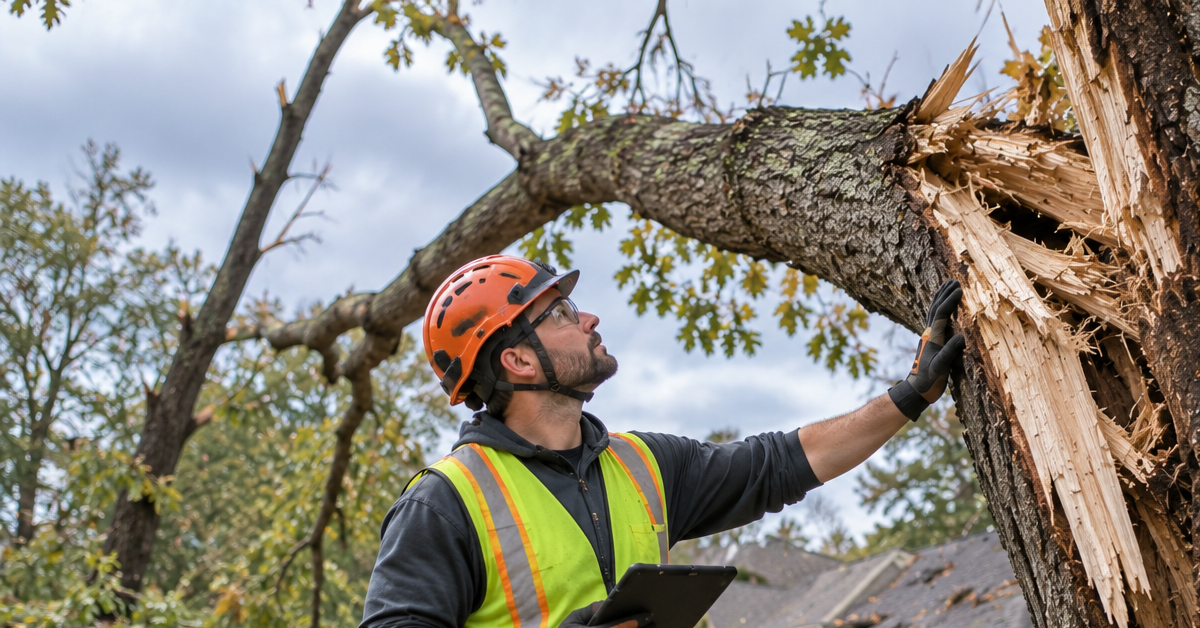
Once you have confirmed that the surrounding area is safe, inspect the trunk from the ground. Use several viewing angles, but stay outside the area where the tree or damaged limbs could fall.
Strong wind can cause a trunk to flex and split. It can also pull apart co-dominant stems, which are two or more large upright sections growing from the same narrow union. Ice adds weight to the canopy, while a lightning strike may fracture bark or damage wood inside the tree. A trunk can remain upright after the storm even when part of its structural support has been lost.
Look for changes that were not present before the storm, including:
A small scrape on the outer bark is different from a deep split through structural wood. The difficulty is that you may not be able to tell how far the damage extends from the ground. Do not insert tools into a crack, pull loose bark away, or strike the trunk to test it. Those actions will not provide a reliable safety assessment and may put you too close to a compromised tree.
Peeling bark may also reveal older decay that the storm exposed. If you see soft wood, fungal growth, a hollow area, or darkened material inside a fresh opening, the damage may involve more than the visible surface. A tree can still have green leaves even when its trunk has been weakened.
Contact our team for an inspection if you see a fresh split, an opening at a major union, or bark loss that exposes a large area of wood. Treat the situation as urgent if the crack is widening, the trunk is making noise, the canopy moves independently from the base, or the tree could strike a home, driveway, or utility line. Our arborist consultation service can help determine whether the tree should be monitored, pruned, supported, or removed.
A quick glance at the ground will not tell you everything that happened overhead. Many storm-damaged branches do not fall immediately. They may remain partly attached, twist into nearby limbs, or hang high in the canopy until another gust brings them down.
Stand well away from the tree and scan from the lower branches to the top. If possible, view the canopy from more than one safe direction. Look for fresh, light-colored wood where a limb tore away. Compare the shape of the canopy with how the tree looked before the storm.
Warning signs can include:
Hail may strip leaves and damage smaller twigs without creating an immediate structural emergency. Ice storms can have a more obvious effect, bending limbs under added weight or causing multiple breaks throughout the crown. Either type of damage can reduce the tree’s ability to recover, especially if it already had deadwood or weak branch unions.
Do not walk beneath a hanging limb to see where it is attached. Do not climb the tree, set up a ladder, pull a suspended branch with a rope, or shake nearby limbs. A partly detached branch can fall with very little warning. Wind after the main storm may also shift broken wood that seemed stable a few minutes earlier.
Leave chainsaw work to trained professionals when storm-damaged limbs are bent, twisted, pinned, or supporting other wood. Wood under tension can split, roll, or spring toward the person making the cut. Even a limb on the ground may be storing enough force to move suddenly.
Our team can determine whether selective tree trimming and pruning is enough to restore a damaged canopy. If the trunk and roots remain stable, careful removal of broken or hazardous limbs may allow the tree to recover. Severe canopy loss, a split main leader, or damage over a structure may require a different plan.
Heavy rain can create a serious problem below ground. Much of Eastern Oklahoma has clay soil, and prolonged rain can leave it saturated. When the soil loses strength, a tree’s root system may shift under the weight of a wet canopy and the pressure of straight-line winds.
First, consider whether the tree leaned before the storm. Some healthy trees grow at an angle and remain stable for years. A new lean, or an existing lean that has noticeably increased, deserves prompt attention.
From a safe distance, look around the base for:
Do not stand on lifted soil or press exposed roots back into place. Avoid driving equipment or parking a vehicle near the root area. A partially uprooted tree can settle, rotate, or complete its fall after the storm, especially while the ground remains wet.
Root movement is more urgent when the tree is large or close to a house, road, driveway, play area, or neighboring property. A tree with a lifted root plate is actively losing anchorage and should be treated as unstable. Keep people and pets out of the possible fall zone and contact our team for a professional assessment.
In some cases, a minor concern can be documented and monitored. In others, tree removal is the safer option because the root system can no longer support the tree. We look at the lean, trunk condition, root stability, nearby targets, utility hazards, and site access before recommending the next step.
Your first inspection should not be your last. Some storm damage takes time to show. A tree may look normal the morning after a thunderstorm, then begin dropping leaves, opening a hidden crack, or leaning as saturated ground continues to shift.
Take a few clear photos from the same safe locations after the storm. Those images give you a reference if you notice a change later. Recheck the tree after the soil begins to dry and after the next period of moderate wind, but do not enter a restricted area to do it.
Watch for delayed symptoms such as:
Changes in foliage do not automatically mean the tree must be removed. Leaf loss can be a stress response, and some trees recover with time and proper pruning. The condition of the trunk, roots, major unions, and remaining canopy matters more than any single symptom.
That is why a professional inspection is useful when the damage is unclear. Our team can walk the property with you, examine the tree and surrounding conditions, and explain whether it appears safe to monitor or needs corrective work. We provide honest recommendations, including leaving a tree alone when that is the appropriate choice.
If the tree is stable but has damaged limbs, repair pruning may be enough. If it has a split trunk, failed roots, severe structural damage, or a high likelihood of striking a structure, removal may be necessary. For widespread debris, downed trees, or multiple hazards across the property, our storm damage cleanup service can address the damaged wood and cleanup needs.
After an Eastern Oklahoma storm, safety comes before cleanup. Stay on the ground, keep your distance from unstable trees and suspended limbs, and never approach a downed power line. If you see an immediate hazard, call Checotah Tree Service at (918) 358-0020 for 24/7 emergency service. If the concern is not urgent but you want a clear answer about the tree’s condition, contact us to schedule a free consultation.
What Our Clients Say

Highly recommend Checotah Tree Service! They were professional, efficient, and did an amazing job from start to finish. It's hard to find a company that takes this much pride in their work, but they definitely delivered. If you're needing tree work done, Jeff is the guy to call.
Excellent work and will be using again! They removed a large tree close to my house, ground two stumps, and cleaned everything up beautifully including blowing sawdust off my porch. They even placed the wood in the perfect spot for burning. I will definitely recommend them!
These guys were absolutely amazing. They cut down two trees that were between power lines and next to the house. They cleaned up the area and left it in better shape than when they arrived. I will recommend them to anybody who is looking for tree removal and I will definitely use them again.
Fantastic job! The crew took out a large tree located in my front yard with careful precision and did an amazing job of cleaning up. Regular updates of pics and videos throughout the process and very reasonable price.
Excellent, professional service! They did the work they quoted in a timely manner, and even cleaned up a few extra problem roots. These are my go-to guys for tree work from now on!
Jeff & his crew did an outstanding job. I had quite a challenging job & they absolutely nailed it. I have more trees to remove this fall & I can tell you they are the only company to call.
If you've got a tree concern anywhere across Eastern Oklahoma, the next step is straightforward.
Call Checotah Tree Service today at
(918) 358-0020
for your free consultation.
Checotah Tree Service • Checotah, OK • (918) 358-0020 • 24/7 Emergency Service

From the first phone call to the final cleanup, here's how a Checotah Tree Service project actually runs.
Call (918) 358-0020 or contact us online. For emergencies, we dispatch a crew immediately. For routine work, we schedule a free on-site consultation at a time that works for you. Phone and virtual consultations are also available at no charge.
We come out to the property, walk it with you, evaluate the trees and the access, identify any safety concerns, and ask about anything we need to know before quoting. This is the conversation where you tell us what you've noticed, and we tell you what we see - including honest recommendations on what work is needed and what isn't.
Detailed written estimate covering scope, timeline, and total price, locked in by our No-Surprise Guarantee. Take your time deciding - there's no pressure to sign on the spot, and the quote is good whether you book now or in a couple of weeks.
Crew arrives on time, walks the plan with you, executes the work safely and efficiently, and completes a full cleanup before leaving. A final walkthrough confirms you're satisfied with the result.
Fill out the form below, and we'll get back to you.