106715 Belle Dr, Checotah, OK 74426, United States
Open 24/7
106715 Belle Dr, Checotah, OK 74426, United States

- Services
- About Us
- Service Area
- Gallery
- Testimonials
- Blog
- Contact Us
CLICK TO CALL US NOW (918) 358-0020
September 17, 2026
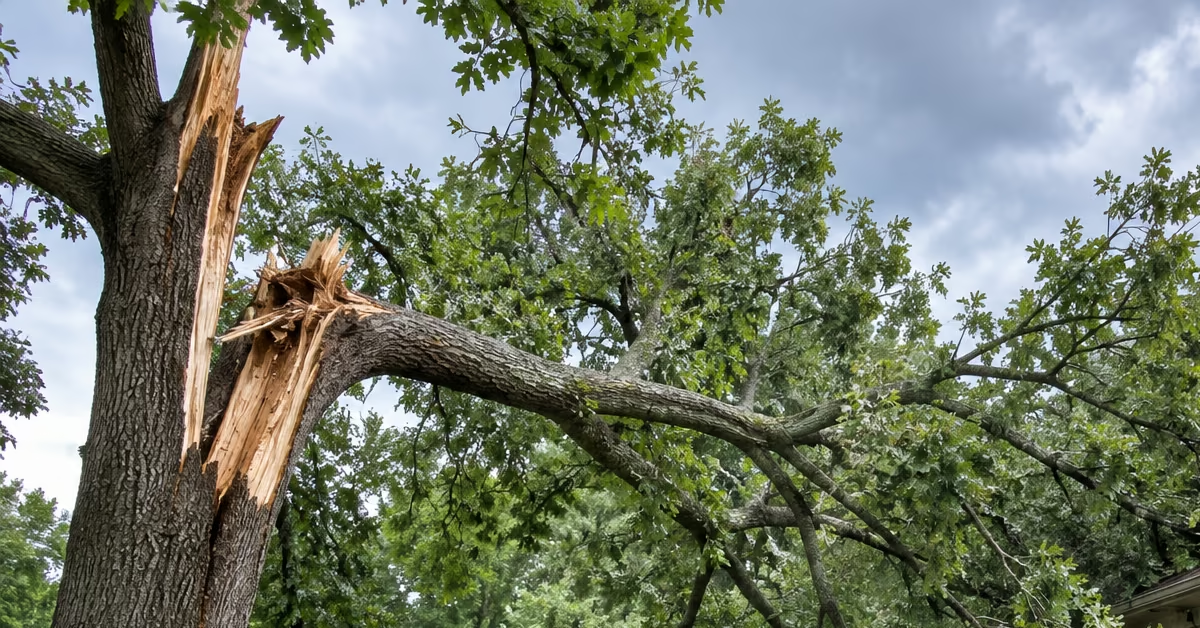
Eastern Oklahoma oaks become storm hazards when structural weakness combines with severe weather. This happens most commonly during spring and early-summer thunderstorms with straight-line winds above 60 miles per hour. Winter ice storms can also create hazards by loading branches with hundreds of pounds of glaze within hours. Mature post oaks, blackjack oaks, bur oaks, and water oaks are especially vulnerable when they already have decay, storm-weakened limbs, or root damage from drought. Healthy wood can often withstand conditions that a compromised tree cannot.
Recognizing the warning signs before severe weather arrives gives property owners the best chance to address a hazard proactively rather than reactively.
Eastern Oklahoma sits inside what’s commonly called Tornado Alley, and the region’s weather pattern combines several hazard types that most other parts of the country don’t face together.
Straight-line winds from severe thunderstorms are the leading cause of catastrophic oak failure across Eastern Oklahoma, more so than tornadoes themselves. This is largely because they affect a much broader area and occur far more frequently throughout the spring and summer months. Straight-line winds test a tree’s root anchoring and trunk strength directly, and a tree with even moderate internal decay or a shallow, compromised root system can fail under wind loads that a structurally sound tree would handle without issue.
Ice storms present a different kind of threat because the danger comes from accumulated weight rather than wind force. A single ice event can add hundreds of pounds of glaze to a mature oak’s branches. This weight often concentrates on weaker limb unions, existing cracks, or previously damaged branches, causing them to snap even in relatively calm conditions.
Major ice storms have historically brought down thousands of trees across Eastern Oklahoma in a single event. This highlights how significant ice-related tree damage can be compared with wind alone.
Certain visible indicators suggest an oak has an elevated risk of failure during the next major storm. Property owners who know what to look for can often catch these issues well before severe weather arrives.
Two oaks with identical structural weaknesses don’t carry equal risk if one stands over a house, driveway, or power line and the other stands in an open field. Proximity to structures, vehicles, outbuildings, and areas where people or pets regularly spend time determines the real-world consequence of a failure, even when the underlying probability of that failure is similar. This is why a professional risk assessment weighs both the tree’s condition and its position relative to what it could damage or who it could harm.
Trees growing in tight clusters, especially where root systems may be interconnected, also warrant particular attention, since the failure of one tree during a storm can sometimes destabilize or damage neighboring trees in the same stand.
A pre-storm inspection by a professional arborist in Checotah, Oklahoma can help prevent costly damage. Early action is usually safer and less expensive than dealing with a tree failure during or after a storm. Deadwood removal, weight reduction, or cabling can address some structural risks. If a tree is too damaged to save safely, removing it before a storm can protect your property and nearby people.
Timing also matters. Late winter is a practical time for inspection and preventive work. This gives property owners time to address problems before the highest-risk storm months of April through June.
Checotah Tree Service helps Eastern Oklahoma property owners identify oak trees that may become dangerous during severe weather. Our team can inspect trees for cracks, decay, weak limbs, root problems, and other structural warning signs. When pruning can reduce the risk, we can remove hazardous or dead branches before storm season.
For trees with serious structural damage, Checotah Tree Service’s experienced arborists can determine whether removal is the safer option. We also provide storm damage cleanup when high winds or ice cause branches or trees to fail. Checotah Tree Service also offers 24/7 emergency tree service to assist homeowners respond quickly when a storm-damaged tree threatens their property. With experienced crews and specialized equipment, we focus on reducing hazards while protecting surrounding structures and landscaping.
Post oak and blackjack oak are common across the Cross Timbers and generally handle wind reasonably well when healthy, but any species with existing decay, cracks, or root damage becomes vulnerable regardless of type.
Yes. Internal decay, root damage, and structural weak points aren’t always visible from the ground, which is why a professional assessment can catch risks a visual inspection alone might miss.
An assessment every few years is reasonable for most mature oaks, with more frequent checks recommended after any major storm event or if you notice new cracks, leaning, or canopy thinning.
Yes. Multi-year drought stress weakens root systems and opens trees to pests and disease, which can make a tree more vulnerable to wind or ice damage even well after the drought conditions have passed.
It depends on the extent of the damage and the tree’s overall structural condition. An arborist can usually determine whether targeted pruning resolves the hazard or whether full removal is the safer path.
Both cause significant damage regionally, but historically, major ice events have brought down extremely high numbers of trees in a single occurrence due to the sudden weight loading involved.
Contact a tree service promptly for an assessment, and in the meantime, keep people and vehicles away from beneath that limb until it has been evaluated and addressed.
Cabling can reduce the risk of splitting at a weak limb union for a tree that’s otherwise healthy and worth preserving, though it isn’t a solution for trees with significant decay or root instability.
| Risk Factor | Why It Matters |
| Straight-line winds | Leading cause of oak failure across Eastern Oklahoma |
| Ice storm loading | Adds hundreds of pounds of unexpected weight to limbs |
| Trunk or limb cracks | Indicates a structurally weak failure point |
| V-shaped branch unions | Prone to splitting compared to broader U-shaped unions |
| Visible decay or cavities | Signals internal weakness not obvious from the ground |
| Recent or worsening lean | May indicate compromised root anchoring |
| Proximity to structures | Determines consequence, not just likelihood, of failure |
The property owners who fare best through Eastern Oklahoma’s storm seasons are the ones who address tree risk before severe weather arrives rather than after. A professional inspection focused specifically on structural weak points, decay, and proximity to structures can identify which oaks need preventive pruning, cabling, or removal, ideally scheduled during late winter ahead of the spring storm months.
Checotah Tree Service has worked with the oaks, storms, and terrain of Eastern Oklahoma for decades of combined experience, and a free consultation is the most direct way to find out whether a tree on your property needs attention before the next major storm arrives.
This article has been reviewed by a licensed arborist to ensure accuracy with storm-related tree failure mechanisms, structural warning signs, and preventive practices relevant to oaks across Eastern Oklahoma’s climate.
What Our Clients Say

Highly recommend Checotah Tree Service! They were professional, efficient, and did an amazing job from start to finish. It's hard to find a company that takes this much pride in their work, but they definitely delivered. If you're needing tree work done, Jeff is the guy to call.
Excellent work and will be using again! They removed a large tree close to my house, ground two stumps, and cleaned everything up beautifully including blowing sawdust off my porch. They even placed the wood in the perfect spot for burning. I will definitely recommend them!
These guys were absolutely amazing. They cut down two trees that were between power lines and next to the house. They cleaned up the area and left it in better shape than when they arrived. I will recommend them to anybody who is looking for tree removal and I will definitely use them again.
Fantastic job! The crew took out a large tree located in my front yard with careful precision and did an amazing job of cleaning up. Regular updates of pics and videos throughout the process and very reasonable price.
Excellent, professional service! They did the work they quoted in a timely manner, and even cleaned up a few extra problem roots. These are my go-to guys for tree work from now on!
Jeff & his crew did an outstanding job. I had quite a challenging job & they absolutely nailed it. I have more trees to remove this fall & I can tell you they are the only company to call.
If you've got a tree concern anywhere across Eastern Oklahoma, the next step is straightforward.
Call Checotah Tree Service today at
(918) 358-0020
for your free consultation.
Checotah Tree Service • Checotah, OK • (918) 358-0020 • 24/7 Emergency Service

From the first phone call to the final cleanup, here's how a Checotah Tree Service project actually runs.
Call (918) 358-0020 or contact us online. For emergencies, we dispatch a crew immediately. For routine work, we schedule a free on-site consultation at a time that works for you. Phone and virtual consultations are also available at no charge.
We come out to the property, walk it with you, evaluate the trees and the access, identify any safety concerns, and ask about anything we need to know before quoting. This is the conversation where you tell us what you've noticed, and we tell you what we see - including honest recommendations on what work is needed and what isn't.
Detailed written estimate covering scope, timeline, and total price, locked in by our No-Surprise Guarantee. Take your time deciding - there's no pressure to sign on the spot, and the quote is good whether you book now or in a couple of weeks.
Crew arrives on time, walks the plan with you, executes the work safely and efficiently, and completes a full cleanup before leaving. A final walkthrough confirms you're satisfied with the result.
Fill out the form below, and we'll get back to you.