106715 Belle Dr, Checotah, OK 74426, United States
Open 24/7
106715 Belle Dr, Checotah, OK 74426, United States

- Services
- About Us
- Service Area
- Gallery
- Testimonials
- Blog
- Contact Us
CLICK TO CALL US NOW (918) 358-0020
June 18, 2026
Quick answer: Regular tree trimming keeps your trees healthier, lowers the risk of storm damage, helps prevent expensive property repairs, and extends the life of your trees. In Eastern Oklahoma, where thunderstorms, ice storms, and straight-line winds hit hard, routine trimming is one of the most important things a homeowner can do to protect their property.
Most homeowners think about their trees only after something goes wrong. A branch falls on a fence. A storm tears off half the canopy. A neighbor complains about limbs hanging over the property line. By that point, the damage is already done.
Trees grow every single year. The risks grow with them. Routine trimming is the small step that prevents the big problem.
When a tree goes years without proper trimming, several things start to happen at once.
The canopy gets heavier and denser. Air movement through the branches drops. Sunlight stops reaching inner limbs, which weakens them. Dead wood collects in the upper crown. Branches grow longer than the parent limb can safely support. Crossing limbs rub each other and create open wounds where insects and disease enter the tree.
What looks like a healthy, full tree from the street can actually be a structural problem waiting for the next storm.
A 20-foot oak in your front yard is very different from that same oak at 50 feet. The leverage on the trunk increases. The weight on lateral limbs multiplies. The reach over your roof, your driveway, your power lines, and your neighbor’s fence stretches further every season.
The most common problems we see when trees are left alone for too long:
A tree that has not been trimmed in 8 or 10 years is rarely a small project. It is almost always a bigger, more expensive job than the small annual trim that would have prevented it.
Many homeowners assume only damaged or diseased trees need to be trimmed. That is one of the most common misconceptions in tree care.
Healthy trees need pruning for three main reasons:
Structural pruning. Young and mid-aged trees benefit from light, strategic cuts that improve their long-term shape. Removing weak attachments early prevents major failures later.
Weight distribution. Even a healthy tree can grow lopsided. Strategic trimming balances the canopy and reduces stress on the trunk and root system.
Growth management. Trees naturally produce more wood than they can support. Selective thinning removes redundant growth and lets the tree put energy into the limbs that matter.
A well-maintained tree is not a tree that has been cut back hard. It is a tree that has been guided carefully over the years.
Most of the problems that regular trimming prevents are problems you do not see until they become serious.
Disease spread. Dead and dying branches act as entry points for fungal infections. Removing them early stops the spread.
Insect infestations. Borers, beetles, and other pests target weakened wood. Pruning out compromised limbs reduces habitat for them.
Branch failures. Cracks, splits, and weak attachments often hide under leaves. Trained eyes spot them during a routine trim.
Poor airflow. A dense canopy holds moisture against leaves and bark, which encourages mildew and rot. Thinning the canopy improves airflow and dries out problem areas.
Root stress. When a tree carries too much weight up top, the root system works harder than it should. Lighter, balanced canopies put less strain on the roots, especially in saturated Eastern Oklahoma soils.
The International Society of Arboriculture has consistently emphasized that proper pruning is one of the most valuable preventive measures a homeowner can take. You can read more about safe pruning standards through Trees Are Good.
Trees in Checotah, Eufaula, Muskogee, McAlester, and the surrounding lake communities deal with weather that most other parts of the country never see in a single year.
Spring brings violent thunderstorms with hail and straight-line winds that can exceed 70 miles per hour. Summer adds heat stress and drought cycles that weaken root systems. Fall mixes warm days with sudden cold snaps that confuse the tree’s dormancy cycle. Winter delivers ice storms that load every branch with hundreds of pounds of extra weight.
The 2007 ice storm and several events since have shown how quickly even healthy-looking trees can fail when they are not properly maintained. Heavy lateral limbs, overgrown canopies, and unbalanced trees are the first to break.
Regular trimming reduces the surface area that storms can grab onto. It also removes the dead, weak, and poorly attached wood that fails first.
Oaks dominate the landscape across McIntosh County and the Lake Eufaula area. They are strong, long-lived trees, but their heavy lateral limbs need attention. Old oaks with extended branches over homes are some of the most common storm damage calls we get.
Pecan is a Cross Timbers native and a beloved Oklahoma tree, but it has notoriously brittle wood. Pecans drop limbs in almost every major storm. Thinning the canopy and removing weak attachments dramatically reduces failure rates.
Silver maples and other fast-growing maples have weak, brittle wood. They grow large quickly and shed limbs just as quickly when wind and ice hit. The Oklahoma State University Extension Service has consistently warned that fast-growing trees like silver maple need extra attention because of their weak wood structure.
Bradford pears are famous for splitting down the middle as they age. Their narrow branch angles cannot support the weight they eventually carry. No amount of trimming fully fixes a mature Bradford pear, but careful structural pruning when they are young can extend their useful life.
Oklahoma’s state tree is smaller and easier to manage, but redbuds still benefit from cleanup pruning, deadwood removal, and shaping. Neglected redbuds become tangled and susceptible to canker diseases.
We see the same mistakes over and over.
Topping: Cutting the top off a tree to control its height is one of the most damaging things you can do. It causes weak regrowth, decay, and long-term decline. Reputable arborists never top trees.
Over pruning: Removing more than 25 percent of a tree’s canopy in a single season stresses the tree, sometimes fatally. Less is almost always more.
Wrong timing: Pruning at the wrong time of year can spread disease, reduce flowering, or weaken winter hardiness.
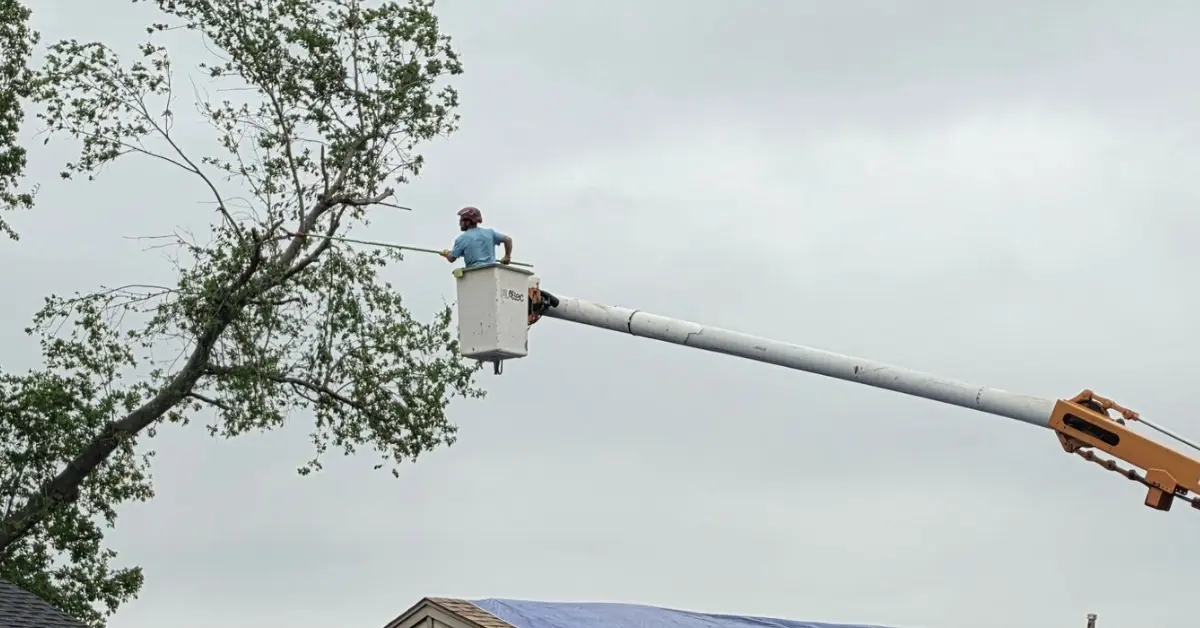
DIY ladder work: Chainsaws and ladders are a dangerous combination. Most serious tree care injuries involve homeowners trying to do work that should be done from a bucket truck or with proper climbing gear.
Flush cuts: Cutting a branch flush with the trunk removes the branch collar, which is the tissue that seals the wound. Flush cuts cause long-term decay.
The right cut at the right time on the right branch is what good arborists do. Everything else is gambling with the health of the tree.
The best time to trim most trees in Oklahoma is late winter, roughly mid-January through early March, while the trees are still dormant but close to breaking bud. This is the standard recommendation from the Oklahoma State University Extension.
Late winter pruning offers several advantages:
There are exceptions. Spring flowering trees like flowering dogwood, crabapple, redbud, and forsythia should be pruned right after they bloom. Pruning them in winter removes the flower buds. Oaks should never be pruned during active oak wilt season in spring and early summer.
Storm damage and clearly hazardous limbs can be removed at any time of year. Waiting on a hazard is more dangerous than trimming in the wrong season.
This is the part most homeowners only learn after a storm.
A routine trim on a healthy tree is a scheduled, controlled job. The crew shows up with the right equipment, makes the planned cuts, hauls off the debris, and leaves.
Emergency tree work is the opposite. A tree has already failed. There may be damage to the roof, the fence, the vehicle, or the power line. The crew has to work around the damage. Hours run longer. Insurance gets involved. Cleanup costs more.
The price difference is usually significant. One scheduled trim every two to four years almost always costs less than one emergency call after a single storm event.
The trees that fail in storms are rarely random. They are usually the trees that were already showing warning signs nobody addressed.
The pattern is remarkably consistent across our service area.
The trees that fail are almost always the ones with:
When we walk a property for the first time and tell a homeowner which trees are likely to cause problems in the next big storm, we are almost never guessing. The signs are usually obvious to a trained eye, but easy to miss for someone who sees the tree every day.
Trees are an investment. A mature shade tree adds real value to your property, lowers your cooling costs, and improves how your home looks. Losing one to preventable damage is expensive and frustrating.
Regular trimming is the easiest, cheapest, and most effective way to protect that investment.
If it has been more than a few years since your trees were last looked at by a professional, now is a good time to schedule a walkthrough. We will tell you exactly which trees need attention, which can wait, and which are showing signs you should not ignore.
Related services:
Call Checotah Tree Service at (918) 358-0020 for a free quote, or send us photos through the website.
What Our Clients Say

Highly recommend Checotah Tree Service! They were professional, efficient, and did an amazing job from start to finish. It's hard to find a company that takes this much pride in their work, but they definitely delivered. If you're needing tree work done, Jeff is the guy to call.
Excellent work and will be using again! They removed a large tree close to my house, ground two stumps, and cleaned everything up beautifully including blowing sawdust off my porch. They even placed the wood in the perfect spot for burning. I will definitely recommend them!
These guys were absolutely amazing. They cut down two trees that were between power lines and next to the house. They cleaned up the area and left it in better shape than when they arrived. I will recommend them to anybody who is looking for tree removal and I will definitely use them again.
Fantastic job! The crew took out a large tree located in my front yard with careful precision and did an amazing job of cleaning up. Regular updates of pics and videos throughout the process and very reasonable price.
Excellent, professional service! They did the work they quoted in a timely manner, and even cleaned up a few extra problem roots. These are my go-to guys for tree work from now on!
Jeff & his crew did an outstanding job. I had quite a challenging job & they absolutely nailed it. I have more trees to remove this fall & I can tell you they are the only company to call.
If you've got a tree concern anywhere across Eastern Oklahoma, the next step is straightforward.
Call Checotah Tree Service today at
(918) 358-0020
for your free consultation.
Checotah Tree Service • Checotah, OK • (918) 358-0020 • 24/7 Emergency Service

From the first phone call to the final cleanup, here's how a Checotah Tree Service project actually runs.
Call (918) 358-0020 or contact us online. For emergencies, we dispatch a crew immediately. For routine work, we schedule a free on-site consultation at a time that works for you. Phone and virtual consultations are also available at no charge.
We come out to the property, walk it with you, evaluate the trees and the access, identify any safety concerns, and ask about anything we need to know before quoting. This is the conversation where you tell us what you've noticed, and we tell you what we see - including honest recommendations on what work is needed and what isn't.
Detailed written estimate covering scope, timeline, and total price, locked in by our No-Surprise Guarantee. Take your time deciding - there's no pressure to sign on the spot, and the quote is good whether you book now or in a couple of weeks.
Crew arrives on time, walks the plan with you, executes the work safely and efficiently, and completes a full cleanup before leaving. A final walkthrough confirms you're satisfied with the result.
Fill out the form below, and we'll get back to you.